This past week I was discussing the safety of dyes with my new on-line friend Carolynn. She had given up using dyes 30 years ago over concerns about the health risks associated. I advised her to email Paula Burch about a specific concern she had regarding the presence of benzene in Procion MX Fibre Reactive Dyes (these are the dyes I use). Paula Burch is an expert on dye chemistry (and has a Ph.D. in Biology) from Rice University. Paula responded with a most thorough and informative post on her blog.
This reminded me that I had written an article regarding dye safety in my quarterly e-newsletter back in February 2009. I also had contacted Paula Burch for an opinion about the scary stories I had been hearing that I suspected were just that: scary stories. I've reprinted my article below, or you can access the original e-newsletter in my newsletter archive.
In the last few months I have heard a number of scary stories and misinformation circulating about the safety of dyes. For example, at an out of town quilting conference I met a world-renowned quilting teacher who reported to me that most of the early fabric dyers have died from exposure to dyes. I am plagued by a rather questioning and cynical nature and this sounded very dubious to me. The safety of dyes is a regular topic of discussion on the on-line DyersLIST, of which I am a member. We all take the issue seriously and if this story is true we would have heard about it there. When I see some evidence that the dyes I use are harmful (when used responsibly) I will be the first to discontinue their use, but I won’t be swayed by heresay.
It also occurred to me that the early dyers started out in the 1970’s (with the advent of the Art Quilt Movement) when most of them were probably in their 50’s (the average age of most students in my classes). This would put them now well into their 80’s and 90’s, which is a very good life span. Many of the early dyers who started dyeing at a younger age, like Caryl Bryer Fallert, are alive and well and have reported that they didn’t always take proper safety precautions (such as protective masks) in the early days.
Whenever I want to find out the scoop on anything dyeing related I turn to the experts on the DyersLIST. In particular, I value the opinion of Paula Burch, who holds a Ph.D. in Biology from Rice University . The topic of Burch’s Ph.D. dissertation was dye chemistry, oxygen radicals, the photodynamic effect, and DNA damage. You can visit her website at http://www.pburch.net/. In the dyeing section you will find valuable instructions about dyeing and information about dye safety.
It is important to distinguish which dyes you are talking about because not all dyes are created equal. I am speaking here specifically about Procion MX fibre-reactive dyes. Some of the early dyes used may very well have been more dangerous than what we use today. There seems to be a trend now among some dyers toward using more natural and eco-friendly dyes. But as Paula Burch states, “The claim that natural dyes are inherently safer than synthetic dyes is the result of ignorance.” Many natural dyes require the use of mordants that contain metals that can be highly toxic. Paula's response to my question is still available on-line.
Be aware that you can always ask for the MSDS safety sheets from dye suppliers. In fact, many companies have them available on-line. I have researched these for the dyes I use, and they all state that there are no high or moderate level risks associated with Procion MX fibre reactive dyes, but all contain some warnings with regard to people with a pre-disposition to asthma.
Burch goes on to say that “No hand dyer has ever been killed by exposure to Procion MX dyes. The real risk of working with Procion MX and other fiber reactive dyes is that of developing a respiratory allergy to the dye. You must be careful to avoid breathing the dye powder in order to reduce your risk of developing this problem.”
Burch also offers the following wisdom on the environmental impact of Procion MX dyes. “If you are dyeing by hand, by yourself, there is no harm in the relatively small quantities of dye that you may dump down the drain. There is more danger to you and your
children in the neurotoxins commonly applied to your neighbors' lawns as insecticides, and the fertilizers applied to your neighbors' lawns are far more harmful to the environment than the dyes you dispose of, as fertilizer run-off leads to the production of oxygen-free dead zones in the oceans and the Gulf of Mexico.”
The dyes and chemicals we use in the fibre-reactive dyeing process should always be treated with proper precautions. This means a safety mask or respirator to prevent inhalation of dye powder, protective gloves, and dedicated dyeing tools. Dye powder is very fine and light and can easily become airborne. Because it is attracted to wet or damp surfaces, placing a damp newspaper on the surface you are working on while mixing dyes will help cut down on the amount of powder that can circulate in the air.
If you are a dyer who would like to learn more about dyeing and have access to a group of knowledgeable experts, you may be interested in becoming a member of the DyersLIST.

ELAINE QUEHL, Quilt Artist, Teacher, Dyer, Designer
Thursday, November 24, 2011


Wednesday, November 23, 2011
What Magazines Do You Read?
What magazines do you like to read and subscribe to? I thought I would share my list of favorite magazines.
1. Professional Artist
 I confess that the main reason I subscribe to this magazine is because Creativity Coach, Eric Maisel, writes a column for each issue. At present, in fact, the website features his column from the current issue. In it he discusses the reason why so many artists start projects but don't finish them. Check it out. I think you will find it interesting. I've read many books by Maisel, and studied with him, both on-line and in person. Professional Artist also contains some very useful articles about things like pricing your work, teaching workshops, marketing yourself, etc.
2. Quilting Arts
 While I don't subscribe to Quilting Arts, I do usually purchase it from the newstand. I buy it strictly to keep on top of trends, learn about techniques, and read feature articles about particular artists.
3. SAQA Journal
 The SAQA Journal comes as part of my SAQA membership. The Journal is a fabulous resource for professional artists and is probably the only really serious magazine out there for those focused on the quilt as fine art and making a career as a quilt or fibre artist.
4. Machine Quilting Unlimited
 I subscribe to Machine Quilting Unlimited mainly because I am a teacher of machine quilting, and it helps me keep on top of new trends. I also like the "In the Art Studio" column that appears in each issue. Machine Quilting Unlimited has been very supportive of my work as well. After Kit Robinson spotted my quilt at a show at the Whistler Museum of Art a few years ago, my work was featured on the Jawdropper page, and I was invited to be the "In the Art Studio" artist this past July. As an aside, watch for a blog post coming up that talks about the importance of getting your work out there. None of this would have happened if I didn't send my work out into the world. There is a lot of material in the magazine that is more relevant to long-arm quilters, but not every magazine can be all things to all people.
5. Canadian Quilter
 What can I say? I am Canadian, I teach mainly in Canada, and I like to keep up on what is happening on the quilt scene in Canada. The Canadian Quilter comes as part of my membership in the Canadian Quilters Association.
Aside from these I sometimes purchase art magazines that feature the kinds of art I like. I encourage students to look at art in other media and in my Art Quilt Series classes circulate art magazines among the class to encourage students to do the same. I think looking at art in other media helps one develop a more artful eye and helps you become more attuned to good design.
1. Professional Artist

2. Quilting Arts

3. SAQA Journal

4. Machine Quilting Unlimited

5. Canadian Quilter

Aside from these I sometimes purchase art magazines that feature the kinds of art I like. I encourage students to look at art in other media and in my Art Quilt Series classes circulate art magazines among the class to encourage students to do the same. I think looking at art in other media helps one develop a more artful eye and helps you become more attuned to good design.
Monday, November 21, 2011
Just in Time for Christmas
Have you noticed that they started playing Christmas songs on the radio in early November this year? People will be all Christmased out by December! I for one am celebrating already because I have just narrowly escaped jury duty (at least for now). But in the spirit of the season, and while there is still time to order them and receive them before Christmas, I want to introduce you to two new books that will make great Christmas gifts for any artist, art quilter, or art quilt lover on your list.
Martha Sielman, the Executive Director of Studio Art Quilt Associates (SAQA) is fast becoming a major author and curator in the art quilt world. Following on her hugely successful Masters Art Quilts, Vol 1 (published in 2008), Lark Books has just recently released her Masters Art Quilts, Vol 2.
 Just like in Masters Vol. 1, Masters Vol. 2 brings us another 40 outstanding contemporary quilt artists with luscious photos of their work and an essay about each one's artistic influence and methods. This time Sielman delves into the interesting backgrounds of many of these artists.
Masters Vol. 1 is still available and comes highly recommended by me. It focuses more heavily on North American artists, whose names we are all familiar with (such as Hollis Chatelain, Jane Sassaman, Joan Schulze, Yvonne Porcella, Katie Pasquini-Masopust, Susan Shie, Inge Mardal & Steen Hougs, Michael James, and Velda Newman). It also includes Canadian artists Pamela Allen and Cher Cartright.
Masters Vol. 2 is far more international in scope. While it does include names well known in North America, such as Jane Dunnewold, Paula Nadelstern, Laura Wasiloski, Elizabeth Busch, Emily Richardson, and Tim Harding, it also contains a lot of artists that are new to me, and some that I have only recently learned about. Dorthy Caldwell is the one Canadian featured in Vol. 2. I find myself particularly enamoured with the elegant portraits by Dutch artist Leslie Gabrielse, and the very poignant and emotional portraits by French artist Genevieve Attinger. American artist, Alice Beasley's portraits and still lifes are absolutely captivating as well.
Studio Art Quilt Associates (SAQA) also publishes a book each year called "Portfolio". This year's is Vol. 18, and as always it includes one art work by each of SAQA's Professional Artist members. I own copies from the last 5 or 6 years. Each year I enjoy poring through Portfolio, enjoying the variety of styles and being inspired by the creativity of my colleagues.

Both books can be purchased from the SAQA Bookstore.
Martha Sielman, the Executive Director of Studio Art Quilt Associates (SAQA) is fast becoming a major author and curator in the art quilt world. Following on her hugely successful Masters Art Quilts, Vol 1 (published in 2008), Lark Books has just recently released her Masters Art Quilts, Vol 2.

Masters Vol. 1 is still available and comes highly recommended by me. It focuses more heavily on North American artists, whose names we are all familiar with (such as Hollis Chatelain, Jane Sassaman, Joan Schulze, Yvonne Porcella, Katie Pasquini-Masopust, Susan Shie, Inge Mardal & Steen Hougs, Michael James, and Velda Newman). It also includes Canadian artists Pamela Allen and Cher Cartright.
Masters Vol. 2 is far more international in scope. While it does include names well known in North America, such as Jane Dunnewold, Paula Nadelstern, Laura Wasiloski, Elizabeth Busch, Emily Richardson, and Tim Harding, it also contains a lot of artists that are new to me, and some that I have only recently learned about. Dorthy Caldwell is the one Canadian featured in Vol. 2. I find myself particularly enamoured with the elegant portraits by Dutch artist Leslie Gabrielse, and the very poignant and emotional portraits by French artist Genevieve Attinger. American artist, Alice Beasley's portraits and still lifes are absolutely captivating as well.
Studio Art Quilt Associates (SAQA) also publishes a book each year called "Portfolio". This year's is Vol. 18, and as always it includes one art work by each of SAQA's Professional Artist members. I own copies from the last 5 or 6 years. Each year I enjoy poring through Portfolio, enjoying the variety of styles and being inspired by the creativity of my colleagues.

Both books can be purchased from the SAQA Bookstore.
Saturday, November 19, 2011
The Art Quilt Series
I've been on the road so much that I have not been blogging much about what I've been doing locally. Since September, I've been teaching my "Art Quilt Series" of workshops once a month at Dragonfly Fabrics here in Ottawa. The series runs until February. The class has 8 students, which makes it a bit more personal than when I ran it at a local community centre. It is also the same class I've been teaching in a one-week format at the Haliburton School of the Arts the past two years.
Today was Session 3, and the topic was fabric dyeing. Students were introduced to two types of low-water immersion dyeing. One exercise involved learning about colour mixing by dyeing a 12 step colourwheel using three parent dye colours. The second exercise involved learning my very free method of dyeing multi-coloured fabrics. Students who had already taken a dyeing class with me got to work on another dyeing project of interest to them.

Some students also brought their completed design exercises from the last class, when they were introduced to two methods of designing. The first method is a fly by the seat of your pants method that involves cutting free-hand and responding to the design as it develops. There may or may not be a photo used as inspiration. Students are required to select a composition (i.e. horizontal, vertical, diagonal, radiating, etc.) that will enhance their idea and to have one of the elements and principles of design dominate.
In this first work Josée used seat of the pants design, with the aim of evoking a feeling of impatience, and in that light she named the piece "Waiting". The vertical composition is certainly appropriate for this since it commands a feeling of strength and dominance. I almost feel like hurrying up because I'm afraid this guy is going to lose his cool! The choice of warm colours to depict impatience is also a good one ... cool colours would have conveyed calm.

Lynn, who describes herself as usually meticulous, said she let herself go with this design and we all described it as her satchel of creativity. Very appropriately, she chose to create a piece in an irregular shape for this.

The second design exercise involves creating a pattern to work from. Students are required to work with a range of 5-7 values of the same colour for this one, and are once again asked to choose a composition to enhance their idea.
Josée created this abstract design in a value gradation of blues. We looked at it in four different orientations and agreed that, from a design point of view, it worked in all four! When seen vertically, some saw an embryo, horizontally some saw water. The curved lines running in an almost diagonal direction give the piece a wonderful feeling of movement.
 This is the design Jeannie came up with for the second exercise. She chose to do an iris in a value gradation of purples. We all loved the focal point in the upper left corner, which drew our eye into the piece before moving around the flower. Jeannie brought the piece to class with a heavy dark border pinned to it.
 I suggested she consider not using a border, and once she had removed it, most of us agreed that the piece was now able to breathe. The border was too harsh and really boxed the design in.
 I am not a big fan of sewing borders on an art quilt once it is finished. All too often I think they are added as the logical next step because that is what we do with bed quilts. I probably wouldn't bind this work either, but instead face it, and perhaps mount or frame it. Small works like this have more presence when appropriately presented. All this reminds me that I should dig up the article I wrote called "To Border or Not to Border: It's All About the Design" for the Fall 2009 SAQA Journal. I will want to post a link on the side of the blog where it is easily accessed, but first I have to figure out how to do that.
Today was Session 3, and the topic was fabric dyeing. Students were introduced to two types of low-water immersion dyeing. One exercise involved learning about colour mixing by dyeing a 12 step colourwheel using three parent dye colours. The second exercise involved learning my very free method of dyeing multi-coloured fabrics. Students who had already taken a dyeing class with me got to work on another dyeing project of interest to them.

Some students also brought their completed design exercises from the last class, when they were introduced to two methods of designing. The first method is a fly by the seat of your pants method that involves cutting free-hand and responding to the design as it develops. There may or may not be a photo used as inspiration. Students are required to select a composition (i.e. horizontal, vertical, diagonal, radiating, etc.) that will enhance their idea and to have one of the elements and principles of design dominate.
In this first work Josée used seat of the pants design, with the aim of evoking a feeling of impatience, and in that light she named the piece "Waiting". The vertical composition is certainly appropriate for this since it commands a feeling of strength and dominance. I almost feel like hurrying up because I'm afraid this guy is going to lose his cool! The choice of warm colours to depict impatience is also a good one ... cool colours would have conveyed calm.

Lynn, who describes herself as usually meticulous, said she let herself go with this design and we all described it as her satchel of creativity. Very appropriately, she chose to create a piece in an irregular shape for this.

The second design exercise involves creating a pattern to work from. Students are required to work with a range of 5-7 values of the same colour for this one, and are once again asked to choose a composition to enhance their idea.
Josée created this abstract design in a value gradation of blues. We looked at it in four different orientations and agreed that, from a design point of view, it worked in all four! When seen vertically, some saw an embryo, horizontally some saw water. The curved lines running in an almost diagonal direction give the piece a wonderful feeling of movement.


Thursday, November 17, 2011
The (Not So) Glamorous Life of a Travelling Quilt Instructor
This year I would have loved to travel to the Houston Quilt Festival, but I had already been booked to teach well in advance. When my colleagues and friends go off to the SAQA/SDA Conference in March 2012, I will be on the road teaching. The teaching dates were booked well before the conference dates were advertised. I have this fantastic facility in my community called the Shenkman Arts Centre. A satellite of the Ottawa School of Art is housed inside and so there are wonderful art classes only 5 minutes from my home. I'd like to take an art class this winter, but discovered that I will miss at least half the classes due to my teaching/travel schedule.
Recently it was suggested to me by a colleague that I might consider cashing in some of my air miles and travelling around the country to promote SAQA. First of all, I have only begun to have teaching engagements that require flying so I don't have any airmiles. But perhaps the biggest point I want to make here is that I CAN and DO promote SAQA on nearly every teaching trip I take. In addition, I provide brochures and back issues of SAQA Journals in my Art Quilt Series classes and my classes at the Haliburton School of the Arts. I've noticed that there is a certain attitude among some of my colleagues (fortunately not many of them) that I am being selfish in pursuing my teaching career, and that I only do things that benefit me. If I had a full time career in any other field, no one would expect me to book trips to promote SAQA, nor expect me to curtail my career for volunteer work. Isn't it just possible I can do more to promote SAQA by being out there being a living, breathing example of someone who has made a career with her quilts?
I recently heard a story about a west coast teacher who came to Ontario to teach for several guilds. At the end of one engagement she waited for the next group she was booked with to pick her up. No one did. I found this a strange story ... that is, until recently.
I have lectures and workshops scheduled in the Greater Toronto Area over a two week period in March 2012. There are gaps between some of these engagements. Since I have no place to stay during many of these gaps I have arranged to drive an hour to Waterloo where my sister lives. Some teachers would have asked all groups to share in paying for or providing accommodations during these gaps, but I did not do so because some of these groups are small guilds and the cost would have been prohibitive. However, in some cases I am charging for mileage to bring me back to Toronto from Waterloo.
Recently I received an email from a group about an hour and a half outside Toronto. They were interested in having me come to their city to deliver a trunk show and lecture. The timing was such that I would be coming to them from Waterloo, but would have had a one night gap after my lecture and before my next engagement in the Toronto area. I asked that this group accommodate me for that one night. In response I received an email telling me that this guild's policy is to not provide accommodations for trunk shows, and that the next group on the trip should be providing this. Well the next group in this engagement had also only hired me to do a trunk show and was already providing me with a billet on the night after the trunk show. There was no way on earth they should have been responsible for a billet on the night before the trunk show as well. So because I had no place to sleep that night the booking didn't happen. It seems to me a bit unreasonable, and even downright unhospitable, to expect a teacher to travel hours from her home in winter and not even provide a bed and pillow. If your policy is to not provide accommodations for trunk shows, then you can expect to only have trunk shows by local people.
In addition, this group expected the next group to pay the mileage to get me back to Toronto. I could maybe see that point, except that the contracts had all been signed with the groups in the Greater Toronto Area, and at this point I cannot add additional charges. However, the guild in question was not even being charged for any portion of the mileage to get me to Toronto, something that the Toronto might have legitimately protested.
So there you have it. I write this email not as a general WHINE, but so you can get a glimpse behind the scenes of a travelling quilt instructor. The reality is that I delivered 71 workshops this year, travelled a total of 14 days to get to and from these workshops, meaning a total of 85 days away from home, not including days where I had gaps between bookings. That means I was away from my home for 3.5 months of this year. It does affect whether or not I can do a lot of other things (including housework ;-)), but I wouldn't trade it for any of the mind-numbing and soul-destroying office jobs I worked at. It is still the best option for me.
Wednesday, November 16, 2011
A Hosta Class and Pattern?

Part of the reason I have not offered a class or published a pattern is my concern that having copies of my hosta quilts out there might devalue them. They will no longer be one-of-a-kind. Although my primary focus is not on selling my work, I do sell some of it, and have sold more hosta and foliage works than any other series I have made. Collectors might not be so happy to know there are copies out there. It is also these quilts that have gotten me into many shows, more than any other works.
Most of my classes are designed to help students make something unique. I encourage this, and don't necessarily want to encourage others to copy me. One exception is the "In Full Bloom" class. It is impossible to design an original floral quilt in a one day class, so I provide patterns in the one day class so students can learn about value and how to construct one of these quilts while using one of my patterns.
There are a few patterns out there that have been made so many times that you will see them in every guild show. There are some that if I never see a quilt made from them again it will be too soon. Many people, particularly across Ontario, have taken my In Full Bloom class, and I often hear about students entering them in their guild's show. It has crossed my mind that one day someone will say the same thing ... "there is another one of those damned Elaine Quehl poppies";-))

I taught a lot of In Full Bloom classes last year, and it got to the point where people started expecting me to provide the hand-dyed fabrics for them. I simply can't keep up all the dyeing when I'm away teaching so much. Would people expect the same if I taught a hosta class? Would they want to use the same fabrics I use?
I do need to make a living, so if interest in my classes should ever wane, will I want to start teaching a class on how to make a hosta quilt? Maybe that will depend on what series I am working on at the time. If I have moved on to something else, it might feel OK to teach a hosta class. Still I would rather encourage students to find their own imagery, although I know not everyone will want to do this.
What do you think? Hosta class or not?
Tuesday, November 15, 2011
The Burlington Fibre Arts Group at the Burlington Arts Centre
I returned tonight from a week long teaching trip (5 days of classes, two days of travel). I taught three classes at Greenwood Quiltery in Guelph and two days of classes for the Burlington Fibre Arts Guild in Burlington.
The Burlington Fibre Arts Guild is a small group of fibre artists who are members of, and meet regularly at, the Burlington Arts Centre in the city of Burlington, Ontario. Burlington is part of the Greater Toronto Area, and is located on the western end of Lake Ontario.
 I was invited to teach my two-day "In Full Bloom" class. Students bring their own photo and create their own pattern. You can see the group hard at work here.
 During my visit I was billetted at the lovely home of Jacqueline Harris and her husband Ed.
By the end of the second day there were a few pieces well underway, and some nearing completion. The flowers are built on muslin, allowing flexibility in possible backgrounds when finished.
Barbara:
 Sandy:
 These are Karen's daffodils.
 The Burlington Arts Centre is a wonderful facility with galleries and display areas.
 In the middle is a lovely greenhouse, with an inviting area to sit and relax.
 The beautiful gift shop is packed with art in a variety of media.

I have three more workshops to deliver in the Ottawa area before Christmas, but teaching related travel doesn't begin again until January 23 when I head to Yellowknife. This week I have to get receipts and paperwork from the last several months organized and to my accountant. You'll be hearing from me more often for a while because I have some topics I want to talk about. Stay tuned!
The Burlington Fibre Arts Guild is a small group of fibre artists who are members of, and meet regularly at, the Burlington Arts Centre in the city of Burlington, Ontario. Burlington is part of the Greater Toronto Area, and is located on the western end of Lake Ontario.


By the end of the second day there were a few pieces well underway, and some nearing completion. The flowers are built on muslin, allowing flexibility in possible backgrounds when finished.
Barbara:


I have three more workshops to deliver in the Ottawa area before Christmas, but teaching related travel doesn't begin again until January 23 when I head to Yellowknife. This week I have to get receipts and paperwork from the last several months organized and to my accountant. You'll be hearing from me more often for a while because I have some topics I want to talk about. Stay tuned!
Tuesday, November 1, 2011
Quilts=Art=Quilts
This past weekend was a bit of a whirlwind. I delivered a free-motion quilting class at the Country Quilter in Richmond, Ontario on Saturday, and after class we headed to Auburn, New York to see the Quilts=Art=Quilts exhibition at the Schweinfurth Memorial Art Centre. I did not enter the show this year, but it has been a tradition for several years now that friends and I take a road trip to see the show. I also wanted to be there on opening weekend since my friend Deb Bein had a work in the show and would be driving up from Poughkeepsie, NY. We arrived in the area around 8 p.m. Saturday night for our reservation at one of my favorite restaurants, Rosalie's Cucina in Skaneateles, NY.
On Sunday morning there was a brunch held for all exhibiting artists and visitors at the lovely Springfield Inn. Elin Noble, one of the jurors of the Quilts=Art=Quilts show spoke before the brunch about the jurying process. We learned a bit about what it was like to jury this competitive show, and Ellen advised that we should not try to guess what the jurors and judges are looking for, but to make what we need to make as artists. She also shared that she had a work rejected from three different shows prior to recently winning an award at a show for the same quilt. One of my friends wrote on a piece of paper "CRAP SHOOT" and handed it to me. Sometimes it does indeed feel like a crap shoot entering a juried show.
Outside the window of the restaurant at the Springfield Inn, I noticed hostas turning gold.

After brunch we headed to the Museum to view the quilts. I managed to capture Deb with her work, "Generation Gap"
 Deb is always full of beans and always has a name tag that in itself is a work of art to wear to every show she is juried into. Here is the tag she was wearing.
 Isn't it cool? She often makes name tags to coordinate with the quilt she has in the show, but in this case the nametag coordinates with her outfit (and another quilt she had in a different show).
I was also pleased to chat with Pat Pauly from Rochester, NY, whose work I have admired for some time. She had two works in the show and let me take these photos. First is Mummy Bags/Canopic Jars, which she won first prize for. Congratulations Pat!
 This is the other work Pat had in the show. I'm afraid I've forgotten the title.

All in all, an enjoyable show. A little more abstract and a little less diverse than last year's show, but always a pleasure to see art quilts where they show best, on a gallery wall!! Quilts=Art=Quilts runs until January 12, 2012.
On Sunday morning there was a brunch held for all exhibiting artists and visitors at the lovely Springfield Inn. Elin Noble, one of the jurors of the Quilts=Art=Quilts show spoke before the brunch about the jurying process. We learned a bit about what it was like to jury this competitive show, and Ellen advised that we should not try to guess what the jurors and judges are looking for, but to make what we need to make as artists. She also shared that she had a work rejected from three different shows prior to recently winning an award at a show for the same quilt. One of my friends wrote on a piece of paper "CRAP SHOOT" and handed it to me. Sometimes it does indeed feel like a crap shoot entering a juried show.
Outside the window of the restaurant at the Springfield Inn, I noticed hostas turning gold.

After brunch we headed to the Museum to view the quilts. I managed to capture Deb with her work, "Generation Gap"


I was also pleased to chat with Pat Pauly from Rochester, NY, whose work I have admired for some time. She had two works in the show and let me take these photos. First is Mummy Bags/Canopic Jars, which she won first prize for. Congratulations Pat!


All in all, an enjoyable show. A little more abstract and a little less diverse than last year's show, but always a pleasure to see art quilts where they show best, on a gallery wall!! Quilts=Art=Quilts runs until January 12, 2012.
Friday, October 28, 2011
Frequently Asked Questions
There are a number of questions I am frequently asked about products I use, so I thought I would address these in a blog post.
What batting do I use?
If I had a dollar for every time I am asked this question, I would be a rich woman! It happens after nearly every trunk show, and in nearly every workshop I teach. Here is the answer: Quilters Dream Cotton. The majority of my quilts contain Quilters Dream Cotton in "Request" weight (their lowest loft batting). I don't need warmth for art quilts, and using a light-weight batting keeps the quilt flat and light for shipping to shows and storing in small spaces. I am often asked if I've tried bamboo batting, etc. No, I haven't, I am very happy with Quilters Dream Cotton, Request weight, and have no need to change. I also doubt that my work would look very different with another batting, it just might be thicker or loftier. I'm far more concerned about improving my design than changing my batting.
What cotton do I use for my hand-dyed fabrics?
I use "Combed Cotton Lawn" from TrendTex Fabrics in Port Coquitlam, British Columbia. They are a wholesaler, so you can ask any quilt shop you frequent to order it for you (Item 1377, Colour 10). In order to buy wholesale from TrendTex you need to be a business and you have to meet their first-time minimum order policy of $1,000. I love the high thread count of this cotton, and have not found one that dyes more vibrantly. It is pfd (prepared for dyeing) so you don't need to scour it (just wet and wring before dyeing), and it has a beautiful sheen that shows off the vibrant colour to its maximum.
Why doesn't my raw-edge applique fray?
Two reasons. One is the high-quality, high-thread count cotton I use (details above), and the other is the Steam a Seam fusible web I use in my work (details below).
What fusible web do I use?
I prefer Steam a Seam Lite. There are four Steam a Seam products (all sold by the Warm Company):
1. Steam a Seam: Regular weight fusible with one backing paper.
2. Steam a Seam 2: Regular weight fusible with two backing papers.
3. Steam a Seam Lite: light-weight fusible with one backing paper.
4. Steam a Seam Lite 2: light-weight fusible with two backing papers.
I prefer the light-weight fusible web with one backing paper (Steam a Seam Lite). I don't need the second backing paper and it gets thrown out anyway. Any Steam a Seam product with a "2" after it will have a backing paper on each side (two papers). This means the product has more of the pressure-sensitive, re-positionable adhesive (on both sides actually), but I find the lite one has enough of this property to keep me happy. I find Steam a Seam products easy to use, consistently reliable, and the pressure sensitive adhesive lets me build a design that stays together until I'm sure I want to make it permanent with an iron.
BEWARE: Steam a Seam gets old if you don't store it in an air-tight container! When it is old it starts coming away from the paper and is harder to use.
It only occurred to me a couple of weeks ago, while teaching at the QUINCE Jam Retreat, just how much Steam a Seam gets sold because of me. A student who was registered in all of my classes at this retreat reported that she needed a total of SEVEN meters of Steam a Seam for the classes. Hmmm ... maybe I should tell the company.
What sewing machines do I use?
My main sewing machine is a Bernina 150 that I purchased in 1998. It is simple, easy to use, and good quality. It has all the important features I love: needle down, good stitch, good tension, and a knee lift. I can put the free-motion foot on, drop the feed dogs, and proceed to quilt. I really have no desire for a more updated machine. I also have a small Janome Gem Platinum that is a dynamic little travel machine. It is light, has many of the features of the bigger and more expensive Janomes, and cost very little. I take it with me when I want to sew on the road or when I need to do a demo in class.
Does my sewing machine have a stitch regulator?
No it doesn't. I learned to free motion quilt before stitch regulators. I also love the humanness of "unregulated stitching". It is almost like a hand signature.
Do I have a special quilting frame or long arm?
No. I do all my quilting on my domestic sewing machine.
What kind of sewing machine needles do I use for machine quilting?
For more than a decade, I successfully used the following:
"Quilting" for cotton or polyester threads
"Embroidery" for rayon threads (loosen upper tension 1 or 2 notches)
"Metallica" for metallic threads (loosen upper tension quite a bit, often down to 1.
This system worked so well for me that when I heard about Superior Thread's advice to use a 90/14 needle I paid little attention. However, after testing it, and seeing how much simpler this would make the life of my students, I have switched to recommending Topstitch 90/14 needles only. It means students only need to buy one type of needle, and it works!
What kind of thread do I use?
I have a huge stash of threads I've collected over the last 15 years and will use any brand from that stash if it is the right colour for the project. However, when I go to purchase threads these days it is almost always Superior Threads. The company educates about its products to ensure that you will be successful using them, and all their threads are manufactured in Japan where most of the best quality threads are being made these days. We have our own Canadian educator, Anita Zobens in Dundas, Ontario, who also sells Superior Threads from her website.
Am I ever going to use commercial fabrics again?
That depends. 99% of the time I use my own hand-dyes because low-water immersion dyeing produces a mottled look that mimics the look of dappled light you will see in nature. My work is mostly inspired by nature. There are many batiks and some other commercial fabrics that can produce this look as well, but for the most part I prefer to dye my own and can get a wider range of values this way. I can't see me ever using calicoes and florals or patterned fabrics again, but never say never.
Wednesday, October 26, 2011
Too Much Fabric, Part 2
A friend wrote this morning and told me she was killing herself laughing about my "rob Peter to pay Paul" method of organization! She then reminded me that there was an important stash of fabric missing from my photos, and that would be my fabric store! Well the truth is that my fabric store doesn't fit in my house anymore so it resides in the trunk of my car, where it is always with me when I go on the road. People all over Ontario shop from my trunk!


Then I remembered the two bins of fabric under the guest bed. These are my older hand-dyes, from the days when I used a variety of cotton fabrics. I use these as backings, for samples, and sometimes take some of them to my Art Quilt Series class in case there is a colour students need for their design exercises.

This reminds me that there is also a bin of these fabrics in the back seat of my car because I couldn't bear to bring it back in the house and mess up all the organization I've accomplished.
And there is the drawer in the guest bedroom desk that contains pieces that didn't fit other drawers because they contained many colours, as well as some of the better older pieces. Sheesh. The chest I posted yesterday that contains the hand-dyed fabrics organized by colour is also in the guest bedroom. I really wish there were room in my studio, but that would mean moving the three large bookcases out, and I can't even bear the thought now.

I put the new pantry together today, and determined that if I put all the bins of green hosta fabric inside, there won't be enough room for the thread. So one bin is sitting on top of the pantry. The thread fits into the pantry (multi-coloured containers that used to be drawers in my old rickety thread stand). My two stacks of hand-dyes in meter sized pieces also fit. Things are looking up.
 Ok, I put the backing sheet on backwards (brown side showing inside the pantry, white side on back. I'm glad it has doors because I'm not taking all those little finishing nails out!
Let's not talk about the bin of colourwash fabrics under the master bed. I can't bear to get rid of them, even though I have no plans to do colourwash again. Maybe by next week I'll actually get to do some creative work in this organized studio!
Oh, and did you know the term "master" bedroom has been changed to "main" bedroom? Someone recently corrected me as "master" has connotations of the male being the master of the house. I like this new language :-))


Then I remembered the two bins of fabric under the guest bed. These are my older hand-dyes, from the days when I used a variety of cotton fabrics. I use these as backings, for samples, and sometimes take some of them to my Art Quilt Series class in case there is a colour students need for their design exercises.

This reminds me that there is also a bin of these fabrics in the back seat of my car because I couldn't bear to bring it back in the house and mess up all the organization I've accomplished.
And there is the drawer in the guest bedroom desk that contains pieces that didn't fit other drawers because they contained many colours, as well as some of the better older pieces. Sheesh. The chest I posted yesterday that contains the hand-dyed fabrics organized by colour is also in the guest bedroom. I really wish there were room in my studio, but that would mean moving the three large bookcases out, and I can't even bear the thought now.

I put the new pantry together today, and determined that if I put all the bins of green hosta fabric inside, there won't be enough room for the thread. So one bin is sitting on top of the pantry. The thread fits into the pantry (multi-coloured containers that used to be drawers in my old rickety thread stand). My two stacks of hand-dyes in meter sized pieces also fit. Things are looking up.

Let's not talk about the bin of colourwash fabrics under the master bed. I can't bear to get rid of them, even though I have no plans to do colourwash again. Maybe by next week I'll actually get to do some creative work in this organized studio!
Oh, and did you know the term "master" bedroom has been changed to "main" bedroom? Someone recently corrected me as "master" has connotations of the male being the master of the house. I like this new language :-))
Tuesday, October 25, 2011
Studio Organization - How Much Fabric is Too Much?
After seeing the spacious and well-organized studios of some of the quilters I stayed with on my last teaching trip, I came home in the mood to get organized. I spent the last few days combing through IKEA,JSYK, and Canadian Tire, looking for storage solutions.
Every time I dye fabric for my store, I end up keeping a little bit for me. For the last few years I have been putting that fabric whereever I could find a space. There were piles and collections of unrelated fabric all over my studio, in my studio closet, and in the guest room/computer room next door. I simply couldn't stand it anymore. But I also couldn't stand the mess that my stash of batiks and commercial fabrics was in or the state of my studio closet.
So the last few days I've taken all those piles of fabric, sorted them, and placed them in the appropriate drawers. I have a large chest of drawers that contains about half of my hand-dyed fabrics. At the moment it is nicely organized, although the drawers are groaning with the weight!
There is a green drawer, but you should know that it only contains all the greens that I don't use in my hosta quilts. More details on that in a minute.

There is also a blue drawer. Yes, I realize there are a few green pieces in here, but they are part of a blue to green colour run, and there just wasn't enough space in the green drawer for them!

There is a mostly purple drawer, that also contains some pinks and blue-reds.

and a drawer with warm colours (yellows, oranges and reds). You should also know that this drawer doesn't include the bin of fabrics I use(d)? for poppy quilts, or the bin of red fabrics I pulled when I was working on Red Stool.
 Finally, there is a drawer with neutrals and warm earthy tones.
 This drawer does not include the bin of end-of-season hosta fabric.
 Or the 3 bins of green hosta fabric: a bin of lights, a bin of mediums, and a bin of darks.
 There is also a drawer in another piece of furniture that contains all the hand-dyes that were so multi-coloured they didn't fit into a particular drawer.
I've also been working on organizing my studio closet. I purchased 10 collapsible bins for the two upper shelves at JSYK. They are very light, which is an important feature so they don't create too much stress on the upper closet shelves. In a former life, when I was a clothes horse, I once caused the upper shelves to collapse with too many sweaters. I store light things in these bins, like batting, stabilizers, organzas, etc. I also purchased several bins to organize my batiks and black & white fabrics. The bins will allow me to pull the entire drawer of the colour I want without having to move a stack of fabric to get to the one behind. You can see one bin there that is holding a mixed variety of fabrics. I tossed pieces of fabric that fit nowhere into this bin, and will sort it later (later is always my favorite time to tackle messy and unpleasant tasks!).

On the right side of the closet, I organized all my commercial fabrics by colour, and also sorted them into bins by colour. The problem? The bins from IKEA don't quite fit the shelves the way I had hoped, so there are still stacks of fabric behind them.

After all this organization, I find that my two large stacks of hand-dyed meters don't fit back in the closet.

Maybe they will fit into this great little pantry I purchased this morning at Canadian Tire for the great sale price of $49.99 (regularly $89.99).
 The idea when I purchased the pantry was to get rid of my rickety thread storage unit:
 and find a way to store my thread in this cabinet. But it looks like I might need the new cabinet for the 3 bins of green hosta fabric, the bin of end of season hosta fabric, and the two large stacks of hand-dyed meters. Maybe I could move the thread to these wonderful drawer units I bought at Home Sense last year. They sit to the left of my work table.
 Right now they contain some of my photos and surface design products. I suspect the 10 small drawers of thread won't fit in these 6 drawers though, and if they do, where will I put the "stuff" that is in them?
Is there such a thing as "too much"? I confess my stash has gotten the better of me, and I think I need a bigger house!
Every time I dye fabric for my store, I end up keeping a little bit for me. For the last few years I have been putting that fabric whereever I could find a space. There were piles and collections of unrelated fabric all over my studio, in my studio closet, and in the guest room/computer room next door. I simply couldn't stand it anymore. But I also couldn't stand the mess that my stash of batiks and commercial fabrics was in or the state of my studio closet.
So the last few days I've taken all those piles of fabric, sorted them, and placed them in the appropriate drawers. I have a large chest of drawers that contains about half of my hand-dyed fabrics. At the moment it is nicely organized, although the drawers are groaning with the weight!
There is a green drawer, but you should know that it only contains all the greens that I don't use in my hosta quilts. More details on that in a minute.
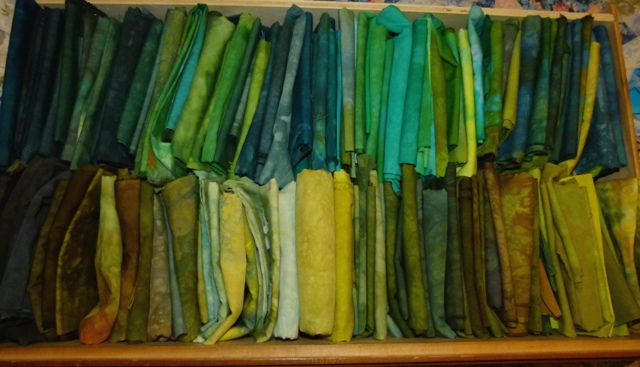
There is also a blue drawer. Yes, I realize there are a few green pieces in here, but they are part of a blue to green colour run, and there just wasn't enough space in the green drawer for them!

There is a mostly purple drawer, that also contains some pinks and blue-reds.

and a drawer with warm colours (yellows, oranges and reds). You should also know that this drawer doesn't include the bin of fabrics I use(d)? for poppy quilts, or the bin of red fabrics I pulled when I was working on Red Stool.


I've also been working on organizing my studio closet. I purchased 10 collapsible bins for the two upper shelves at JSYK. They are very light, which is an important feature so they don't create too much stress on the upper closet shelves. In a former life, when I was a clothes horse, I once caused the upper shelves to collapse with too many sweaters. I store light things in these bins, like batting, stabilizers, organzas, etc. I also purchased several bins to organize my batiks and black & white fabrics. The bins will allow me to pull the entire drawer of the colour I want without having to move a stack of fabric to get to the one behind. You can see one bin there that is holding a mixed variety of fabrics. I tossed pieces of fabric that fit nowhere into this bin, and will sort it later (later is always my favorite time to tackle messy and unpleasant tasks!).

On the right side of the closet, I organized all my commercial fabrics by colour, and also sorted them into bins by colour. The problem? The bins from IKEA don't quite fit the shelves the way I had hoped, so there are still stacks of fabric behind them.

After all this organization, I find that my two large stacks of hand-dyed meters don't fit back in the closet.

Maybe they will fit into this great little pantry I purchased this morning at Canadian Tire for the great sale price of $49.99 (regularly $89.99).


Is there such a thing as "too much"? I confess my stash has gotten the better of me, and I think I need a bigger house!
Wednesday, October 19, 2011
Norfolk County Teaching Trip
Last night I returned from my two week teaching trip. I spent the second week teaching in Norfolk County, Ontario for the Norfolk Quilt Guild and the Norfolk Twilight Quilt Guild (the former meets during the day and the latter meets at night). The largest community in the region would be would be Simcoe. One of the things I love about this area of Ontario is that I can pass through Paris, Delhi, Scotland and Boston in the same day! During my trip I was billetted in three different homes over the week.
I began the week with a lecture and two workshops for the day guild. During this time I stayed at the home of Terry Anderson and her husband Rick. We went out for dinner a few times, including a visit to the Beach House at Port Dover, where we indulged in famous Lake Erie Perch. When I arrived at Port Dover I felt as though I was in the Caribbean! Palm trees grace the shore over the summer, but they are moved someplace warmer over the winter. However, Norfolk County is in a Carolinian growing zone, so I also noticed quite a few other crops and plants that I don't see in other parts of Ontario (tobacco, ginseng, peaches, etc).
Left to right are Terry, Darlene, Mary and me!
 Because this guild chose workshops that produce larger and more time-consuming pieces I don't have photos of any finished pieces yet.
I spent the next four days with the evening guild (four workshops and a lecture). The Twilight Guild organized a day retreat and named it the QUINCE Jam Retreat (Quehl in Norfolk County Extravaganza). What, you may ask, is a Quince? Apparently it is a coarse and bitter apple. On-line encyclopedia Wikipedia doesn't recognize it as growing in Canada, but it does! Generally it is used for jam. I had never seen one before, but student Mary Ann Rich brought one to class for me, and it sat on my table as our mascot each day.
 For the first two nights I stayed with April Maxwell and her husband Paul. Below is a photo of April holding the piece she composed in my "Fast and Fun Fused Designs" class. April is a potter and President of the local Potter's Guild. I wish I had taken a photo of her pottery studio and display area. I did come home with a few pieces of pottery though!
 April and Paul share their home with two very large and beautiful cats, Marty and Duff. What an adorable pair of felines they are! I am not a small woman, but you can see I am pawsitively dwarfed by Marty! What a lovable bundle he is. I couldn't decide between the photo with his eyes open or closed!

 This is Duff. He wasn't so sure about me, but he did show up to cuddle in my bed for about 5 minutes the first night.
 I spent the last two nights at the home of Terry Sonnenberg and her husband John. They share their home with felines Atticus, Caruso and Macy. A feral cat named Cato also shows up outside for meals. That's Terry you see working away near the front of the classroom.
 Atticus followed me to my room my first night there, and made himself comfortable in my bed as soon as I turned the blankets down. He purred, rested his head on my arm, and stretched his paws to touch me. He left the next morning without waking me. By the second night I was yesterday's news and he didn't come back.
 The cats at Terry's house have a beautiful conservatory in the woods to enjoy. It is surrounded by glass windows on all sides.
 This is the handsome Caruso. I did see Macy but she is shy and I was unable to capture her photo.
 Members of the Norfolk Twilight Guild worked hard and made further progress on their collage trees than any class I've taught before. Here are some of the students in the class showing off their trees. When finished, the extra muslin needs to be cut away and the tree appliqued to a background.
 As usual, there are too many photos of student work to share here, but I did want to draw attention to this lovely piece that Stella made in the "Fast and Fun Fused Designs" class.

It is good to be home again. It took me most of today to unpack and put things away. I have deadlines waiting: class descriptions, learning outcomes and marking schemes for next summer's classes at the Haliburton School of the Arts, and preparations for Saturday's Art Quilt class. It is also time to do the research for and purchase a digital projector so I will be prepared for trunk shows I need to fly to.
I began the week with a lecture and two workshops for the day guild. During this time I stayed at the home of Terry Anderson and her husband Rick. We went out for dinner a few times, including a visit to the Beach House at Port Dover, where we indulged in famous Lake Erie Perch. When I arrived at Port Dover I felt as though I was in the Caribbean! Palm trees grace the shore over the summer, but they are moved someplace warmer over the winter. However, Norfolk County is in a Carolinian growing zone, so I also noticed quite a few other crops and plants that I don't see in other parts of Ontario (tobacco, ginseng, peaches, etc).
Left to right are Terry, Darlene, Mary and me!

I spent the next four days with the evening guild (four workshops and a lecture). The Twilight Guild organized a day retreat and named it the QUINCE Jam Retreat (Quehl in Norfolk County Extravaganza). What, you may ask, is a Quince? Apparently it is a coarse and bitter apple. On-line encyclopedia Wikipedia doesn't recognize it as growing in Canada, but it does! Generally it is used for jam. I had never seen one before, but student Mary Ann Rich brought one to class for me, and it sat on my table as our mascot each day.


It is good to be home again. It took me most of today to unpack and put things away. I have deadlines waiting: class descriptions, learning outcomes and marking schemes for next summer's classes at the Haliburton School of the Arts, and preparations for Saturday's Art Quilt class. It is also time to do the research for and purchase a digital projector so I will be prepared for trunk shows I need to fly to.
Subscribe to:
Posts (Atom)